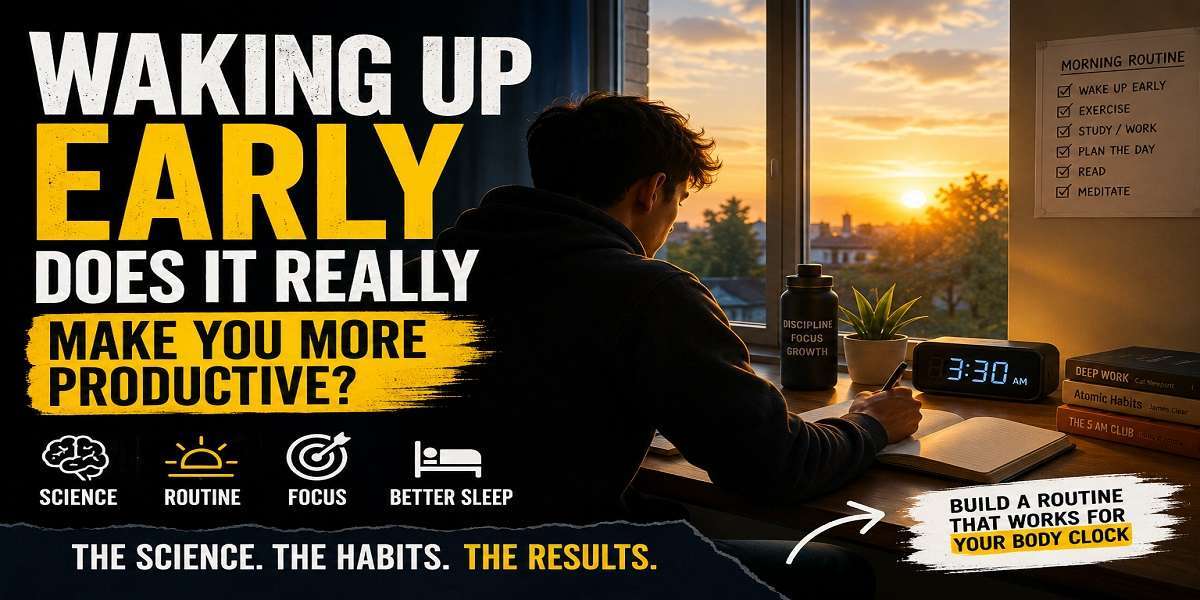
Does Waking Up Early Really Make You More Productive?
There’s something different about being awake while the rest of the world is sleeping.
The streets are quiet. Notifications are silent. Your friends and family are still asleep—and you’re already starting your day.
You wash your face, sit at your desk, exercise, study, or work before everyone else wakes up.
But here’s the question:
Does waking up early actually make you more productive?
The answer may surprise you.
Your Biological Clock Matters More Than You Think
I’ve always been an early riser.
For as long as I can remember, waking up between 3 and 4 AM has felt natural to me.
During medical school, one of my neurology lectures focused on circadian rhythm—the internal biological clock that controls when we feel awake and sleepy.
One important lesson stood out:
People are different.
Some naturally function better in the morning.
Others perform better later in the day.
Human sleep patterns exist on a spectrum—from extreme morning types to extreme night owls.
That means waking up early doesn’t automatically make someone more productive.
And staying up late doesn’t automatically make someone lazy.
What matters most is:
How you use your time.
The Biggest Advantage of Waking Up Early
For me, early mornings provide one major benefit:
Fewer distractions.
There are fewer messages.
Less social media temptation.
Less noise.
This creates the perfect environment for focused work.
Many people describe this state as deep work—periods of uninterrupted concentration where your brain performs at its highest level.
If early mornings help you access that state, they can become incredibly valuable.
How to Train Yourself to Wake Up Earlier (Naturally)
1. Go to Bed Earlier
This sounds obvious, but it’s essential.
Many people try waking up earlier by sacrificing sleep.
That approach usually fails long term.
Lack of sleep can lead to:
- Poor concentration
- Increased anxiety
- Low energy during the day
- Difficulty maintaining routines
For me, around 7.5 hours of sleep works best.
Your ideal amount may be different.
2. Use Light to Your Advantage
Light strongly affects your body clock.
At night:
- Reduce bright screen exposure
- Dim room lights
- Use warmer lighting
Lower light exposure helps support melatonin production—the hormone that prepares your body for sleep.
In the morning:
- Open curtains immediately
- Increase exposure to daylight
- Use brighter, cooler lighting
This signals your body to wake up.
3. Give Yourself a Reason to Wake Up
Getting out of bed becomes easier when you have something meaningful planned.
Ask yourself:
- Do you want to study?
- Exercise?
- Meditate?
- Work on a personal goal?
Purpose creates motivation.
4. Exercise Regularly
Exercise improves more than fitness.
It also supports:
- Better sleep quality
- Faster sleep onset
- More stable energy levels
Morning or afternoon exercise is generally easier on your sleep schedule than intense late-night workouts.
5. Shift Your Sleep Schedule Gradually
Don’t expect overnight results.
Move your bedtime earlier in small steps.
Example:
- Day 1 → Sleep at 12:00 AM
- Day 2 → Sleep at 11:45 PM
- Day 3 → Sleep at 11:30 PM
Small changes are easier for your body to adapt to.
6. Build a Consistent Night Routine
Simple habits can help signal sleep:
- Brushing your teeth
- Changing into sleep clothes
- Turning down lights
- Reading quietly
Consistency teaches your brain when it’s time to rest.
7. Watch Your Evening Nutrition
Eating too close to bedtime may affect sleep quality.
Try to:
- Finish large meals earlier
- Reduce caffeine later in the day
- Avoid excessive sugar at night
Good sleep starts before your head reaches the pillow.
Final Thoughts
People often ask whether waking up at 3 AM is healthy.
For me, it works because it fits my natural rhythm.
That doesn’t mean everyone should do the same.
Some people thrive at 5 AM.
Others do their best work at midnight.
The goal isn’t to copy someone else’s schedule.
The goal is to build a routine that works with your body—not against it.
Because productivity doesn’t come from waking up early.
It comes from using your best hours well.
FAQ
Is waking up early healthier?
Not necessarily. Consistent, sufficient sleep matters more.
How long does it take to become an early riser?
Usually several weeks of consistent habits.
Can night owls become morning people?
Some adjustment is possible, but natural tendencies still matter.